Scotland Damp ProofingDamp & timber · PCA qualified Request a survey
Speak to a surveyor 0800 000 0000 Mon–Fri 8am–6pm

Independent damp & timber surveys · All of Scotland

We read walls.
Then we tell you the truth about them.

Rising damp, penetrating damp, condensation and rot all leave different marks on a Scottish wall. Most are misdiagnosed by whoever is quoting for the treatment. We survey first, we don't sell chemicals, and the report is yours to act on.

RISING PENETRATING CONDENSATION
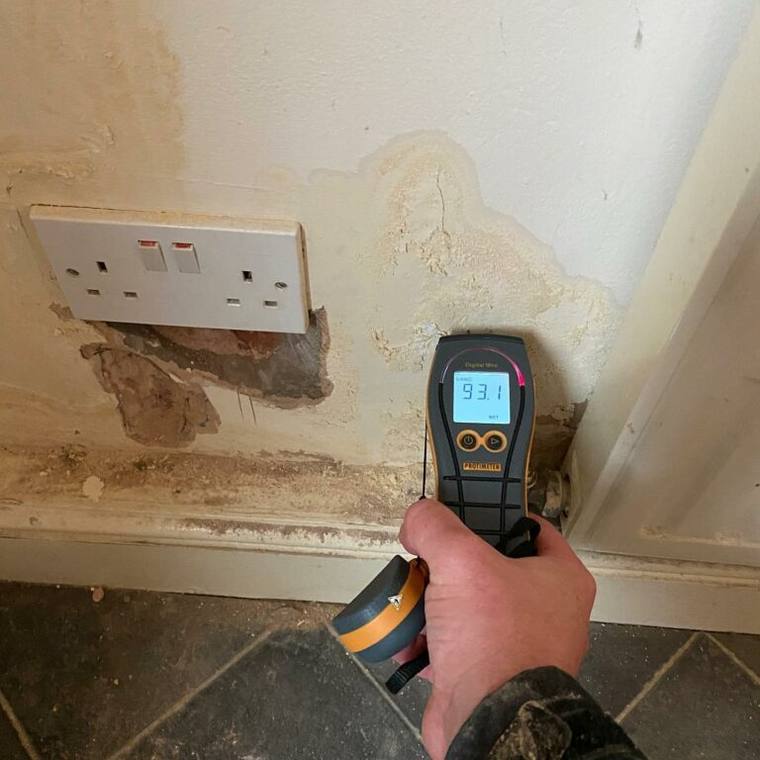
WME0.0% Tap a marker. Wood moisture equivalent at skirting level, 300 mm above floor.
  • PCA qualified — CSRT, CSTDB
  • Independent survey, no tie to a contractor
  • Insurance-backed guarantees
  • Reports accepted by lenders & solicitors
  • Covering the whole of Scotland

Three problems, one symptom

Damp is a diagnosis, not a product.

A tide mark on a Glasgow tenement wall can be four different things. Injecting a chemical damp-proof course fixes exactly one of them. This is what we're separating when we survey.

Groundwater rising by capillary action

Rising damp

Genuinely uncommon, and over-diagnosed for fifty years. It stops at a horizontal tide line, usually under a metre, and carries ground salts that bloom through the plaster. On solid stone walls the cause is often a raised external ground level, a bridged DPC, or a blocked sub-floor vent — not a failed course.

Water crossing the wall from outside

Penetrating damp

The most common cause of a damp Scottish wall. Cracked harling, cement render trapping moisture in a lime-built wall, failed pointing, a leaking downpipe, a slipped slate, a defective chimney flashing. It appears at the point of failure and worsens after rain rather than following the seasons.

Moisture produced inside the building

Condensation & mould

Black spot mould in corners, behind furniture, on cold reveals and single-glazed margins. It is a heating, ventilation and cold-bridging problem, and no chemical treatment will touch it. This is the category most often reported by tenants, and the one Awaab's Law is written around.
The law is changing

Awaab's Law reaches Scotland on 6 October 2026.

From that date the Investigation and Commencement of Repair (Scotland) Regulations 2026 give social and private landlords fixed, countable timescales for damp and mould. Ten working days is not long to find a qualified surveyor who is free.

Days
Hours
Mins
Secs

Until the duties commence.

The 10 · 3 · 5 rule

  1. 10WORKING DAYS

    Investigate

    From the point the landlord becomes aware a property may be affected by damp or mould — by tenant report, inspection, or any other means.

  2. 3WORKING DAYS

    Write to the tenant

    A written summary of what the investigation found, due within three working days of the investigation being completed.

  3. 5WORKING DAYS

    Start the work

    Where the investigation concludes work is needed, it must commence within five working days of that conclusion.

If a timescale can't be met, the landlord must set out in writing why, and when they will comply. General guidance only — see the full note on the landlords page.

Why we charge for the survey

A free survey is a sales visit.

If the person diagnosing your wall is paid only when you buy the treatment, there is exactly one diagnosis they can afford to reach. That is how thousands of Scottish tenements ended up with an injected damp-proof course they never needed, in walls where the real fault was a cracked downpipe two floors up.

We charge a survey fee and we tell you what is wrong, including when the answer is "nothing that needs us". You are free to take the report to any contractor you like. If you want us to carry out the works, the survey fee comes off the price.

Survey fees start at for a single property inspection. Confirmed in writing before we attend, along with your 14-day cancellation rights where the contract is agreed at your home.

Coverage

The whole country, and we know what it's built from.

Blonde sandstone tenements in Glasgow, rubble-cored walls in the Borders, granite in Aberdeen, harled solid walls up the west coast where it rains 200 days a year. The building stock changes every fifty miles and so does the failure mode.

  • Glasgow
  • Edinburgh
  • Aberdeen
  • Dundee
  • Inverness
  • Stirling
  • Perth
  • Paisley
  • Falkirk
  • Ayr
  • Kilmarnock
  • Dunfermline
  • Kirkcaldy
  • Livingston
  • Hamilton
  • Greenock
  • Oban
  • Fort William
  • Elgin
  • Dumfries
  • Galashiels
  • Isle of Skye

Common questions

Before you call anyone.

Including us. Half of what gets reported as damp is a maintenance job that costs a fraction of a specialist's quote.

Almost certainly not, if the staining is above a metre, appears after heavy rain, sits below a window or beside a chimney breast, or shows as black spot growth in a corner. True rising damp is limited, stops at a defined tide line and brings hygroscopic salts with it. We test for those salts rather than relying on a meter reading alone — a protein meter reads conductivity, and salt, foil-backed plasterboard and metal lath all read as "damp".

The Single Survey in your Home Report may note dampness and recommend a specialist report. Lenders frequently apply a retention until that report is produced. A specialist damp and timber report with a costed schedule is normally what releases it, and it is far cheaper to hold that report before the offer than to renegotiate after it.

Very common, and it changes who pays. Where the defect is in a shared roof, gable, close or downpipe, repairs are usually decided and apportioned under the title deeds, or under the Tenement Management Scheme in the Tenements (Scotland) Act 2004 where the deeds are silent or incomplete. Our report identifies the defect and its location precisely, which is what your factor or the other owners will need before anyone agrees to pay.

Report it in writing and keep the date. Your landlord already has duties under the Repairing Standard and the Tolerable Standard, and from 6 October 2026 there are fixed timescales for investigating damp and mould. If the landlord does not comply you can apply to the First-tier Tribunal for Scotland (Housing and Property Chamber). Free independent advice is available from Shelter Scotland and Citizens Advice Scotland — we survey buildings, we are not a tenancy advice service.

Typically 60 to 120 minutes on site for a flat or standard house, longer for a full building. You receive a written report within working days: moisture readings plotted room by room, photographs of every defect, the diagnosis with our reasoning, and a schedule of works separated into what is urgent, what is remedial and what is maintenance you can hand to a joiner or roofer.

Contact

Phone

Email

Office

Covering

The whole of Scotland, mainland and islands. Survey fees from , report within working days.

Find out what's actually wrong.

Tell us what you're seeing. Five questions, no phone call until you want one.

Surveys

What a proper survey
actually involves.

Ninety minutes, a moisture meter, a hygrometer, a borescope, a ladder, and someone who has cut open enough Scottish walls to know what they're looking at.

On site

Internal moisture profile

Readings at skirting level, 300 mm and 1 m on every affected elevation, plotted so the pattern is visible rather than asserted. Surface readings are cross-checked with deep-wall probes, because a conductivity meter reads salt and foil as enthusiastically as it reads water.

On site

Air and surface conditions

Relative humidity, air temperature and surface temperature at the cold spots. This is what distinguishes condensation from moisture arriving through the fabric, and it is the measurement most "free surveys" skip entirely.

On site

External defect inspection

Ground levels against the wall, air brick and sub-floor ventilation, pointing and harling condition, rainwater goods, chimney heads and flashings, and any cement render sitting on a wall that was built to breathe.

On site

Timber and sub-floor

Joist ends where they bear into damp masonry, wall plates, lintels and bearings, plus a lifted board or borescope inspection of the solum where access allows. Rot is found under floors far more often than on them.

Where needed

Salt analysis

Nitrate and chloride testing on drilled samples. Ground salts confirm rising damp; their absence is often the single fact that saves a client several thousand pounds.

Afterwards

The report

Photographic, room by room, with the diagnosis and the evidence for it, then a schedule of works split into urgent, remedial and general maintenance — costed, so you can price it against anyone else's quote.

SURVEY FEE — from · quoted and confirmed in writing before attendance · deducted from the cost of works if you instruct us · report issued within working days

Damp

Telling them apart.

The pattern, the height, the timing and the salts. Four pieces of evidence that between them account for nearly every damp wall in Scotland.

Diagnosis

Rising damp

  • Defined horizontal tide line, typically 0.5–1.2 m
  • Hygroscopic salts present in the plaster
  • Constant through the year rather than after rain
  • Often traced to raised external ground, a bridged or rendered-over DPC, or a blocked sub-floor vent

Where a chemical DPC is genuinely warranted we install one and re-plaster to a salt-retardant specification. Where it isn't, we say so.

Diagnosis

Penetrating damp

  • Localised patch, any height, worst after driving rain
  • Traceable to a defect: cracked harling, open joints, failed pointing, blocked or split downpipe, slipped slate, chimney flashing
  • Cement render or plastic paint on a lime-built wall, holding water in
  • Exposed west-coast elevations taking the brunt of it

The fix is nearly always building repair rather than chemical treatment — which is why our report tells you what to instruct, not what to buy from us.

Diagnosis

Condensation & mould

  • Black spot growth in corners, on cold reveals, behind furniture and inside wardrobes on external walls
  • Worst in winter, worst in bedrooms and bathrooms
  • Driven by cold surfaces, moisture production and too little ventilation
  • Frequently made worse by sealing up an old building

We measure surface temperatures and humidity, identify the cold bridges, and specify ventilation and heating improvements. No chemical treatment resolves condensation.

Diagnosis

Plumbing & defect leaks

  • Sharp, contained, often below a bathroom or kitchen
  • Flat roofs, box gutters, valley gutters and shared close roofs
  • Ingress from the flat above in tenement property
  • Frequently mislabelled as rising damp because it presents low down

Identifying the true source matters commercially as well as technically: it determines whether the cost sits with you, a neighbour, a factor or an insurer.

Timber decay

Rot doesn't stop
where you can see it.

Dry rot is the one Scottish tenements are notorious for, and the one that costs the most when it is found late. Wet rot is more common and far more manageable. Woodworm is usually historic and usually over-treated.

Serpula lacrymans

Dry rot

Rust-red spore dust, cuboidal cracking across the grain, grey-white mycelium and strands that can travel through masonry and behind plaster to reach dry timber several rooms away. It needs a persistent water source — find and stop that first, or the treatment is decoration.

We establish the full extent by opening up, cut back to sound timber with an agreed margin, sterilise the masonry where justified, and specify the building repair that removes the moisture.

Coniophora and others

Wet rot

Darkened, soft, stringy timber confined to the wet area. Joist ends built into a damp gable, window cills, sub-floor plates, the bottom of a door frame. Contained, predictable, and resolved by stopping the water and replacing or resin-repairing the affected timber.

Anobium punctatum

Woodworm

Common furniture beetle in damp sub-floor softwood. The question is never "are there holes" — it is whether the infestation is active, which we assess by frass, bore hole condition and timber moisture content. Historic infestation in dry timber needs no chemical treatment at all.

STRUCTURAL NOTE — where decay has reached joists, lintels or bearings we will tell you plainly that a structural engineer is required. We do not carry out structural design and we will not quote around it.

Where we work

What we find, where.

Scottish building stock is regional. So is the way it fails.

Glasgow & the west

Blonde and red sandstone tenements

Rubble-cored walls with an ashlar face, shared closes and back courts. Failed common downpipes, defective bay window roofs, and cement pointing trapping water in walls built for lime. Dry rot in bay corners and close ceilings is the recurring find.

Edinburgh & the Lothians

Ashlar, basements and drying greens

Sunken basement and lower-ground flats with high external ground levels and poor solum ventilation. Chimney head and skew failures on tall stacks. Retentions on Home Reports are common in the older tenement stock.

Aberdeen & the north east

Granite

Dense, unforgiving walls where the moisture sits at the joints. Pointing failure, harling breakdown on rear elevations and driven rain on exposed coastal frontages. Condensation is severe where solid granite meets modern airtightness.

Highlands, Argyll & the islands

Harled solid walls, high exposure

Rainfall and wind-driven saturation dominate. Harling cracks, breather membranes and vent paths matter more than any chemical treatment. We plan island and west coast work in batches — ask about scheduling.

Dundee, Fife & Perthshire

Mixed stock

Sandstone terraces alongside interwar and post-war cavity housing, where the failure is usually a bridged cavity, debris on wall ties, or an added conservatory raising ground levels above the DPC.

Borders & Dumfries

Rubble walls and red sandstone

Thick, wide-jointed rubble walls that hold water for weeks after a wet spell, and inappropriate modern renders that have sealed them. Sub-floor rot in older cottages with earth or slab-covered solums.

Towns we cover

  • Glasgow
  • Edinburgh
  • Aberdeen
  • Dundee
  • Inverness
  • Stirling
  • Perth
  • Paisley
  • East Kilbride
  • Falkirk
  • Ayr
  • Kilmarnock
  • Dunfermline
  • Kirkcaldy
  • Livingston
  • Hamilton
  • Motherwell
  • Greenock
  • Oban
  • Fort William
  • Elgin
  • Peterhead
  • Dumfries
  • Galashiels
  • Stranraer
  • Isle of Skye

Landlords, agents, factors & housing associations

Ten working days, starting 6 October 2026.

Scotland's version of Awaab's Law is made by the Investigation and Commencement of Repair (Scotland) Regulations 2026, approved by the Scottish Parliament in March 2026 and in force from 6 October 2026. Unlike the first phase in England, it applies to the private rented sector as well as social housing.

Days
Hours
Mins
Secs
  1. 10WORKING DAYS

    Complete an investigation

    Runs from the moment you become aware the property is or may be affected by damp or mould — whether that comes from a tenant report, your own inspection, or any other means.

  2. 3WORKING DAYS

    Issue a written summary to the tenant

    Setting out what the investigation found. Due within three working days of the investigation being completed.

  3. 5WORKING DAYS

    Commence any necessary work

    Where the investigation concludes that work is required to make the property free of damp and mould, that work must start within five working days of the conclusion being reached.

Where circumstances outwith your control prevent compliance, you must set out in writing to the tenant why, and the timescale in which you expect to comply. Where the damp or mould is not the result of a building defect, landlords are expected to work with tenants and signpost appropriate advice and guidance.

The practical problem

Ten working days is a diary problem, not a legal one.

Every landlord and agent in Scotland is subject to the same clock from the same date, and there is a finite number of PCA-qualified damp and timber surveyors in the country. In October, the ones with capacity will be the ones people booked in August.

Priority response scheme

Get on the list before October

A standing arrangement for landlords, agents and factors: a named response window for damp and mould investigations, a report format written to evidence the investigation duty, and a plain-English written summary you can pass straight to the tenant.

No retainer for portfolios under properties. Priced per inspection, with agreed rates fixed for twelve months.

The wider legal picture

What already applied
before October.

The new timescales sit on top of duties that have been in force for years. Damp and mould were never optional.

GENERAL GUIDANCE ONLY — NOT LEGAL ADVICE.
This page summarises Scottish housing law as we understand it for the purposes of explaining our survey work. It is not a substitute for legal advice on your circumstances. Verify against the current legislation at legislation.gov.uk, or take independent advice.

LAST REVIEWED — [DATE] · PREPARED BY — [NAME] · NEXT REVIEW — [DATE]

About

Qualified, insured,
and not selling you anything.

[Company background — who you are, how long in the trade, what you did before. Two or three short paragraphs, first person plural, no marketing language. Mention the qualifications by name and the year you got them.]

[Why you set the business up as independent survey first. This is the differentiator on the whole site — say it in your own words here.]

Qualification

CSRT

Certificated Surveyor in Remedial Treatment — the Property Care Association's core damp and timber surveying qualification.

Qualification

CSTDB

Certificated Surveyor of Timber Decay in Buildings, covering fungal decay and wood-boring insect identification.

Cover

Insurance

. Certificates available on request.

Cover

Guarantees

Long-term guarantees on remedial works, with independent insurance backing available so the guarantee survives the company.

Contact

Talk to a surveyor.

Not a call centre and not a salesperson. If it's a five-minute question, ask it.

TEL  
MOB  
EMAIL  
POST  
HOURS  

Request a survey

Five questions.

Tell us what you're actually seeing and we'll tell you what it's likely to be before anyone visits.

STEP 1 / 5

Who are you?

It changes which report you need.

What sort of building?

Age matters more than anything else here.

Roughly when was it built?

What are you seeing?

Select everything that applies. This is the part that does the work.

Where, and how urgent?

Postcode so we can confirm coverage and travel.

Where do we send the report?

Received.

Thanks — we'll come back to you within hours with a fee, a date, and an honest view on whether you need a survey at all.

Prefer to speak to someone? Call a surveyor direct.